Showing posts with label home mortgage. Show all posts

Tuesday, October 3, 2017

Homebuyers rush to riskier mortgages as home prices heat up

Homebuyers rush to riskier mortgages as home prices heat up

  • The number of adjustable-rate mortgage originations jumped just over 40 percent from the first quarter of this year to the second.
  • Mortgage rates are still very low, historically speaking, but they have been inching up.
  • Buyers this year are struggling with affordability and opting for a lower-rate product.

An aerial view of a retirement community in Central Florida
Carlo Allegri | Reuters
An aerial view of a retirement community in Central Florida
Home prices are heating up yet again, and that is sending more potential buyers looking for ways to afford a monthly mortgage payment.
The number of adjustable-rate mortgage originations jumped just over 40 percent from the first quarter of this year to the second, according to analysis by Inside Mortgage Finance. ARMs offer lower interest rates than fixed-rate loans, and today's ARMs usually have a fixed period of at least five years. That means the rate can change after five years. Still ARMs are considered riskier than the classic 30-year fixed mortgage.
The average contract interest rate on 30-year-fixed mortgages with conforming balances was 4.11 percent last week, according to the Mortgage Bankers Association. Compare that with the rate on a five-year ARM, which was 3.38 percent. The rate on an adjustable-rate loan, by definition, will change after the fixed period, moving higher or lower, depending on the broader market rate.
ARM demand usually rises from the first quarter to the second quarter, because spring is the busiest season for homebuying, and it's when families dominate the market, searching for bigger, higher-priced homes. Still, the jump in ARMs in the spring of 2016 was 15 percent compared with this year's 40 percent jump. This makes the case that buyers this year are struggling with affordability and opting for a lower-rate product.
While mortgage rates remain very low, historically speaking, they have been inching up. The vast majority of homebuyers favored the safety of the 30-year-fixed rate mortgage since the housing crash, but weakening affordability is now changing that.
Home prices have been rising steadily for the past three years, and while it looked like the gains were flattening recently, they appear to be heating up again. Prices nationally jumped 6.9 percent in August compared with August of 2016, the biggest gain in three years. The annual gain in July was 6.7 percent, according to CoreLogic.
"One thing that's helped to fuel demand, and certainly home price growth, as much as the lean inventory of for-sale homes is that mortgage rates have really cooperated," said Frank Nothaft, chief economist at CoreLogic.
Home prices have been rising far faster than inflation, but Nothaft predicts the gains will actually ease next year, if, as he expects, mortgage rates rise. That will be the tipping point, he said, although others argue that tight supply of homes for sale, especially on the low end, will keep prices lofty despite higher mortgage rates.
Already, close to half of the nation's top 50 housing markets are overvalued, in relation to income and employment growth.
"Prices are being driven up by very tight market conditions," noted Matthew Pointon, property economist at Capital Economics. "On a per capita basis, the number of existing homes for sale is at a record low, and buyers are therefore having to up their offers to secure a home."
Pointon said home prices should actually be rising by more than 10 percent, given the tight supply, but tight mortgage lending standards are restricting that growth.
"Cautious appraisals are preventing desperate buyers from bidding too much for a home, as are strict debt-to-income ratios," he said.
While ARM loans are often blamed for the epic housing crash in the late 2000s, the current ARMs are nothing like those of the past. Products like negative amortization loans, which offered very low rates up front but then tacked that initial savings amount onto the loan itself, no longer exist.
Loans must now be fully documented and underwritten to the full length of the loan in order to make sure borrowers can pay even if the rate goes up. Lenders must also make it very clear to borrowers that their rate is only fixed for a certain term, and that it will likely go up after that term, given the current trajectory of rates overall. That, again, was not the case in the past.

Wednesday, August 2, 2017

Mortgage applications slide 2.8%, even as interest rates stay low


  • Total mortgage application volume fell 2.8 percent on a seasonally adjusted basis last week compared with the previous week, according to the Mortgage Bankers Association.
  • Mortgage applications to refinance a home loan fell 4 percent for the week, seasonally adjusted, and were 41 percent lower than the same week one year ago.
  • Mortgage applications to purchase a home, which are far less sensitive to weekly rate moves, fell 2 percent for the week.


Both homeowners and homebuyers are taking a step back from the mortgage market, as stagnant interest rates give them no particular reason to act quickly.
Total mortgage application volume fell 2.8 percent on a seasonally adjusted basis last week compared with the previous week, according to the Mortgage Bankers Association. Volume was 22 percent lower compared with the same week one year ago, due to much lower volume in refinances.
Mortgage applications to refinance a home loan fell 4 percent for the week, seasonally adjusted, and were 41 percent lower than the same week one year ago, when interest rates were lower. Refinance volume is particularly sensitive to weekly rate moves, but rates have been so low for so long that there is a shrinking pool of borrowers who might benefit from a refinance. Rates are currently hovering around the lowest level in five weeks.
The average contract interest rate for 30-year fixed-rate mortgages with conforming loan balances ($424,100 or less) remained unchanged at 4.17 percent, with points decreasing to 0.36 from 0.40 (including the origination fee) for 80 percent loan-to-value ratio (LTV) loans.
"It was an up and down time for rates last week in response to mixed economic news coupled with the Fed's FOMC statement," said Joel Kan, MBA's associate vice president of industry surveys and forecasting. "The statement outlined a mostly healthy outlook, with a slight concern over inflation and the news that balance sheet reduction could begin 'relatively soon.'"
Mortgage applications to purchase a home, which are far less sensitive to weekly rate moves, fell 2 percent for the week. That is the second straight decline and the lowest level since last March. Purchase applications were 9 percent higher than the same week one year ago.
Homebuyers today are less concerned with interest rates and more concerned with overheating home prices and a severe shortage of houses for sale.
Mortgage rates moved even lower to start this week due to some weak economic data.
"GM posted a sharp decline in auto sales," noted Matthew Graham, chief operating officer of Mortgage News Daily. "This builds a case for economic weakness, leading more traders to seek safer returns in the bond market. Excess demand for bonds results in lower interest rates."
A bigger move could come at the end of this week when the Labor Department releases the monthly employment report.
The refinance share of mortgage activity decreased to 45.5 percent of total applications from 46.0 percent the previous week. The adjustable-rate mortgage share of activity decreased to 6.6 percent of total applications.
The Federal Housing Administration share of total applications increased to 10.3 percent from 10.2 percent the week prior. The Department of Veterans Affairs share of total applications decreased to 10.1 percent from 10.5 percent the week prior. The Department of Agriculture share of total applications remained unchanged at 0.8 percent from the week prior.

Robert Bobby Darvish of Platinum Lending Solutions

Thursday, June 15, 2017

Fed Raises Key Interest Rate For 4th Time Since 2015

Fed Raises Key Interest Rate For 4th Time Since 2015


Federal Reserve Chair Janet Yellen speaks to reporters in Washington, D.C., on Wednesday after the Fed announced it would increase interest rates by a quarter-point.
Susan Walsh/AP 
 
Updated at 3:55 p.m. ET.
Federal Reserve policymakers have raised their target for the benchmark federal funds interest rate by a quarter-point, to a range of 1 percent to 1.25 percent.
Despite the increase — the fourth since December 2015 — interest rates remain near historic lows, but the move will mean higher borrowing costs for consumers. The Fed previously raised rates in March, and on Wednesday, it signaled plans for one more rate increase this year.
In a statement Wednesday, the policymakers said that "the labor market has continued to strengthen and that economic activity has been rising moderately so far this year."
The economy grew at a rate of 1.2 percent in the first quarter of this year, about half as fast as it did in the final three months of 2016. Unemployment dipped to 4.3 percent in May, a 16-year low.
"Job gains have moderated but have been solid, on average, since the beginning of the year, and the unemployment rate has declined," the Fed statement said. "Household spending has picked up in recent months, and business fixed investment has continued to expand."
Greg McBride, an analyst with consumer financial site Bankrate.com, tells NPR's Yuki Noguchi that, taken together, the Fed's moves have caused home equity and car loan rates to increase about 1 percentage point over the last two years.
"The combination of rising debt burdens and rising interest rates is starting to strain some households, and we're seeing delinquencies pick up from recent lows," McBride says.
In the wake of the financial crisis, the central bank added Treasury securities and mortgage-backed securities to its balance sheet. Now it's making plans to reduce those holdings, which total more than $4 trillion.
The Fed said it "currently expects to begin implementing a balance sheet normalization program this year, provided that the economy evolves broadly as anticipated."
As Reuters reports:
"The central bank said it would gradually ramp up the pace of its balance sheet reduction and anticipates the plan would feature halting reinvestments of ever-larger amounts of maturing securities.
"The Fed said the initial cap for Treasuries would be set at $6 billion per month initially and increase by $6 billion increments every three months over a 12-month period until it reached $30 billion per month in reductions to its holdings.
"For agency debt and mortgage-backed securities, the cap will be $4 billion per month initially, increasing by $4 billion at quarterly intervals over a year until it reached $20 billion per month."

Robert Bobby Darvish Platinum Lending Solutions Newport Beach CA

Thursday, January 19, 2017

How a one-two, Trump-Yellen punch may move interest rates

How a one-two, Trump-Yellen punch may move interest rates


Sergey Lipinets, (blue gloves) from Moscow, Russia, during his IBF Junior Welterweight Bout against Lenny Zappavigna, (red gloves) from New South Wales, Australia, at the Galen Center at the University of Southern California on December 10, 2016 in Los Ang
Jayne Kamin-Oncea | Getty Images
Interest rates could try recent highs on the potent combination of a hawkish Janet Yellen and the pro-growth talk that is likely to come from Donald Trump in the next couple days.
Trump will be sworn in as 45th U.S. president on Friday, and the markets are looking for him to play up his pledges to push forward tax breaks and infrastructure spending early in his administration. He may also take actions in his first days that reduce regulation and define his commitment to the promises he's made voters. That could be seen as a near-term negative for Treasury prices and would send yields higher.
Already, bond yields were on the rise Thursday, lifted by surprising remarks from Fed Chair Yellen on Wednesday afternoon and economic reports Thursday morning showing decades-low jobless claims, an 11.3 percent jump in housing starts and a two-year high in mid-Atlantic manufacturing activity. Also a factor was the Wednesday report of a jump in headline consumer price index inflation to a more than two-year high of 2.1 percent year over year in December.
"I don't think we're going to see a huge surge in optimism again. We're not going to get another leg off of it, but I also don't think we're going to go back to where we were in October." -Tom Simons, money market economist, Jefferies
In her comments, Yellen said she expects a few rate hikes this year and that the fed funds target rate could get to 3 percent by 2019 — all in line with the Fed's forecasts. But it was Yellen's seemingly confident embrace of those targets that got the market's attention. Markets had been skeptical of the Fed forecast, and many economists had expected just two rate increases this year, not the three in the central bank's projection.
"She certainly gave the market a big push. Just looking at March probabilities, they went from an 18 percent chance (of a rate hike) to 25," said Aaron Kohli, rate strategist at BMO. "The market went from pricing slightly less than two hikes to slightly more than two hikes in 2017." He said expectations in the fed funds futures for a June rate rise went to 93 percent from 85 percent after Yellen spoke.
The 10-year Treasury yield also snapped to 2.43 percent after Yellen spoke and was as high as 2.48 percent Thursday, its highest level since Jan. 3. The two-year yield rose as well, but the curve flattened, meaning the gap between two-year yields and 10-year yields narrowed. The two-year was as high as 1.25 percent Thursday.
Yellen was scheduled to speak again and take questions Thursday evening at 8 p.m. ET at a Stanford University event. The Fed next meets Feb. 1 and while it is not expected to take action, the gathering could result in some more hawkish talk.
Kohli said the next target for the 10-year would be 2.52 percent, and then 2.60 percent.
"After the weekend and Monday, it's going to be very interesting. What happens when we get to brass tacks will be interesting for sure." -Tom Simons, money market economist, Jefferies
The bond market has been consolidating for the past several weeks after the 10-year reached a postelection high of 2.64 percent on Dec. 15. That is the level that could be tested in the near future, strategists say.
"There's a short base that will get even bolder if rates get to that level," Kohli said, adding short bets could add to the growing position sending rates higher. "I think it's very possible you get that kind of spike up. What I would suggest is as soon as that happens you might go the other way."
Money market economist Tom Simons at investment banking firm Jefferies said he doesn't see a big move in yields, but the bias should be toward higher yields, and lower prices. "I don't think we're going to see a huge surge in optimism again. We're not going to get another leg off of it, but I also don't think we're going to go back to where we were in October," he said.
"Next week we'll have two-, five- and seven-year auctions, a little bit of supply, and a light data week, so the focus is going to be on Trump, and for the most part, the first stuff that comes out of the gate is probably going to be (bond) market negative and it will be risk positive," he said.
Simons said he thought the rally in Treasurys, which drove the 10-year yield toward 2.30 percent earlier this week, was overdone.

In the last several weeks, yields fell as investors became disillusioned with the "Trump trade" and the prospects for quick adoption of the president-elect's pro-growth agenda.
Trump did talk up expectations for a tax program or stimulus when he met with the press last week, and that absence raised flags about what he will get done early in his administration. Trump's focus on repealing Obamacare and his comments on tariffs both were concerns for the market, since the issue of altering America's health-care system is seen as a quagmire, while tariffs could spark a trade war.
"After the weekend and Monday, it's going to be very interesting. What happens when we get to brass tacks will be interesting for sure," said Simons.
Kohli said he expects Trump to focus on infrastructure spending and tax cuts. He could make a bigger splash in markets if he announces fiscal spending that can be put to work right away. Tax reform and cuts are also important, but Kohli said that's likely months away.
Strategists expect Trump to push forward quickly on initiatives in his first weeks, and markets will be disappointed if he doesn't. "If he squanders it, that's his downside," said Kohli.

Robert Bobby Darvish Platinum Lending Solutions

Thursday, December 1, 2016

Mortgage rates reach highs not seen in more than a year

Mortgage rates reach highs not seen in more than a year

 
Mortgage rates sustained their upward march this week without any indication that their trajectory will slow anytime soon.
Home loan rates had been on the rise before the election. But since Donald Trump’s victory, they have been on a tear.
According to data released Thursday by Freddie Mac, the 30-year fixed-rate average climbed to 4.08 percent with an average 0.5 point. (Points are fees paid to a lender equal to 1 percent of the loan amount.) The rate was 4.03 percent a week ago and 3.93 percent a year ago. The 30-year fixed rate has now gone up more than half a percentage point in the past three weeks. It hasn’t been this high since mid-July 2015.
The 15-year fixed-rate average jumped to 3.34 percent with an average 0.5 point. It was 3.25 percent a week ago and 3.16 percent a year ago. The 15-year fixed is at its highest level since October 2014.
The five-year adjustable rate average rose to 3.15 percent with an average 0.4 point. It was 3.12 percent a week ago and 2.99 percent a year ago. The five-year ARM hasn’t been this high since late January 2014.
Many observers expect higher rates to endure because of recent strong economic data and the likelihood of a rate increase by the Federal Reserve later this month.
Bankrate.com, which puts out a weekly mortgage rate trend index, found that half of the experts it surveyed say rates will rise in the coming week. Elizabeth Rose, branch manager at Dallas-based Movement Mortgage, is one who says rates are headed higher.
“Expect continued volatility to put pressure on mortgage rates,” she said. “Mortgage bonds were in the process of attempting a recovery. However, some decent economic news the past few days have put a damper on those improvements.”

Higher rates have driven down mortgage applications, particularly those for refinances. According to the latest data from the Mortgage Bankers Association, the market composite index — a measure of total loan application volume — sank 9.4 percent from the previous week. The refinance index tumbled 16 percent, while the purchase index inched down 0.2 percent.
The refinance share of mortgage activity accounted for 55.1 percent of all applications.
“Mortgage application volume in the Thanksgiving week dropped sharply to the lowest level since early January, as mortgage rates increased to their highest point since July 2015,” said Mike Fratantoni, MBA chief economist. “Refinance volume, which is very sensitive to rates, dropped more than 16 percent in the most recent week, with refinances of government loans dropping 30 percent for the week. On a seasonally adjusted basis, purchase volume was little changed last week.  However, the mix continues to shift towards higher balance loans, as the average purchase loan size reached a new survey record.  First-time buyers and buyers of lower priced units may have stepped away from the market to some extent given the jump in rates. It appears that many homebuyers rushed to get their applications two weeks ago as rates began to increase.”

Sunday, September 11, 2016

Interest Rate Hike: What Will The US Federal Reserve Do At Its September Meeting?

Interest Rate Hike: What Will The US Federal Reserve Do At Its September Meeting?


Come Tuesday, investors will be reading the silence ahead of next week’s U.S. Federal Reserve policy committee meeting, with the last word coming Monday afternoon from Fed Governor Lael Brainard, who is scheduled to speak at the Chicago Council on Global Affairs.
Also making appearances earlier Monday are Atlanta Fed President Dennis Lockhart before the NABE conference in Atlanta and Minneapolis Fed President Neel Kashkari at a question-and-answer session in St. Paul, Minn.

Investors sent stocks down nearly 400 points Friday amid indications from two other Fed governors last week that the central bank could raise interest rates at the Sept. 20-21 meeting — something investors had thought was off the table until December.

Brainard is seen as the most dovish member of the Fed board, and Peter Boockvar told CNBC any hawkish comments from her would pretty much guarantee a hike.

“For a stock market that is wholly unprepared for that, not only could it get messy, it will get messy,” he said. “The only reason why we're at these [stock market] levels is because of low interest rates and central bank policy. ... When the Fed removes accommodation, things are seen for what they really are, not for what people want them to be.”

The CME Group fed funds futures indicated there is a 27 percent likelihood of a September rate hike and a 46 percent chance of one in December, TheStreet reported.
A final decision likely will rest on retail sales and producer price data, the Philadelphia Fed Business Outlook Survey, the Empire State Manufacturing Survey and industrial production data out on Thursday, and consumer price data Friday. Friday also constitutes a quadruple witching session.
Jobs data, car sales and data from the services and manufacturing sectors all have undershot forecasts so far this month, Reuters noted.
“It would take a big increase in retail sales, increase in inflation to get the Fed to even think twice [about September],” said Paul Christopher, head global market strategist at Wells Fargo Investment Institute in St. Louis.

Speculation about an interest rate hike also is being fueled by the European Central Bank’s decision not to extend its asset-buying program beyond March.
“Expectations that the Fed could raise interest rates this month are on the upswing again following Thursday’s ECB meeting where it apparently didn’t discuss new stimulus — a shift from dovish to neutral that has opened the door for the Fed to raise interest rates soon,” Colin Cieszynski, chief market strategist at CMC Markets, told MarketWatch.

Monday, September 5, 2016

Trump says U.S. interest rates must change as Fed weighs rate hike

By Steve Holland | YOUNGSTOWN, OHIO
Republican presidential nominee Donald Trump, who has previously accused the Federal Reserve of keeping interest rates low to help President Barack Obama, said on Monday that the U.S. central bank has created a "false economy" and that interest rates should change."They're keeping the rates down so that everything else doesn't go down," Trump said in response to a reporter's request to address a potential rate hike by the Federal Reserve in September. "We have a very false economy," he said.
"At some point the rates are going to have to change," Trump, who was campaigning in Ohio on Monday, added. "The only thing that is strong is the artificial stock market," he said.

Fed Chair Janet Yellen said last month that the U.S. central bank was getting closer to raising interest rates, possibly as early as September, saying that the Fed sees the economy as close to meeting its goals of maximum employment and stable prices. The Fed raised interest rates last December for the first time in nearly a decade, and at that time projected four more hikes in 2016. The Fed later scaled back that projection to two rate hikes this year in the wake of a slowdown in global growth and continued financial market volatility.
Trump, during the primary campaign, as he took on 16 Republican rivals, had called Yellen's tenure "highly political" and said the Fed should raise interest rates but would not do so for "political reasons."
The Fed has been a target of some conservative critics in the U.S. Congress, who say the bank risked sparking inflation with its easy monetary policies in response to the global financial crisis.
Fed officials say their independence is critical to making sound policy decisions.
(Reporting by Steve Holland in Youngstown; Additional reporting and writing by Amanda Becker in Washington; Editing by Leslie Adler)
Brought to you by Robert Bobby Darvish, Platinum Lending Solutions

Tuesday, July 19, 2016

Why the Fed Can't and Shouldn't Raise Interest Rates

The author is the professor of practice and senior director of the Oregon Economic Forum at the University of Oregon and the author of Tim Duy's Fed Watch.
The Federal Reserve eschews balance sheet policy – changes in the amount or composition of assets held by the central bank – in the early stages of its plans to normalize the extraordinary monetary policy it instituted in the wake of the financial crisis. Instead, the Fed’s normalization plans currently focuses on raising the federal funds rate. But the central bank may need to use both rate policy and balance sheet policy simultaneously to reach the objectives of its dual mandate – or price stability with maximum sustainable employment – while sustaining a financial environment consistent with those objectives.
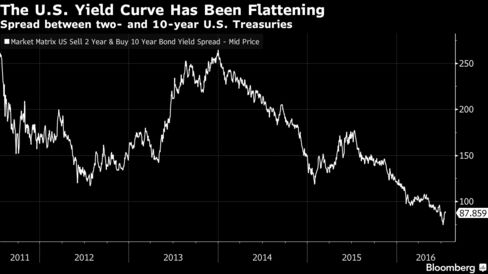
The flattening of the U.S. yield curve as investors see little chance of rates rising in the longer term should serve as a red flag that their focus on short-term interest rates may be doomed to failure.

Source: Bloomberg

One of the defining features of this tightening cycle is the same as the cycles that came before – the yield curve is flattening, and very quickly. The spread between 10-year and two-year U.S. Treasuries has collapsed to 88 basis points at a time when the federal funds target rate is 25-50bps. This suggests that the Fed actually has very little room to raise short-term rates. If additional rates hikes compress the yield curve further, the capacity for maturity transformation – effectively the process of borrowing on shorter time frames to lend on longer time frames – will soon be compromised.
Federal Reserve Governor Daniel Tarullo sees the threat. Speaking with the Wall Street Journal, he said:
Tarullo said he didn't think that the worry that low interest rates may fuel asset bubbles was an “immediate concern.”
The Fed governor, who is the quarterback of the Fed's efforts to regulate banks, questioned whether raising rates would ease financial stability concerns in an environment where the market was pessimistic about the economic outlook.
“If markets do regard economic prospects as only modest or moderate going forward, then raising short-term rates is almost surely going to flatten the yield curve, which generally speaking is not good for financial intermediation, and in some sense could exacerbate financial stability concerns,” Tarullo said.
When rates are low, regulators should pay more attention to financial stability issues "but it doesn't translate into 'therefore raise rates and all will be well,'" he added.
Some of Tarullo's colleagues at the Fed are pushing for rate hikes sooner rather than later on the basis of two economic narratives. The first essentially collapses to a Phillips curve story. In other words, as slack in the labor market decreases, inflationary pressures rise. To stem those pressures, the Fed needs to raise rates early, especially if they want to achieve a slow pace of subsequent rate hikes.
The problem with this story is that the Phillips curve is flat as a pancake, hence the calls for early rate hikes to quell inflationary pressures fall on some deaf ears around Constitution Avenue. This is especially the case after a long period of below target inflation and, perhaps more worrisome, evidence of declining inflation expectations. It is simply hard to build much support for the "we need to raise rates because of inflation" case in this environment.
In the absence of a strong inflation argument to justify rate hikes, some Fed policymakers are leaning more heavily on a second narrative, the financial stability angle — the fear that low rates foster asset bubbles or, perhaps worse, dangerously high levels of leverage within the financial sector.
For instance, San Francisco Federal Reserve President John Williams recently said:
"The risk I think we face in waiting too long, or waiting maybe as long as some of these market expectations are, is that the economy is already pretty strong and if we wait too long in further removal of accommodation I do think imbalances will form more generally. It could show up as more inflation pressures down the road, we're not seeing those yet, but I think that you do see some of this in terms of real-estate markets and other asset markets which are being priced to perfection based on an outlook of very low interest rates. You are seeing extremely high asset valuations in real estate, commercial real estate, the stock market is very strong relative to fundamentals. That is a natural result from low interest rates, that's one of the ways monetary policy affects the economy. But if asset prices, real estate prices, continue to go further and further away from longer-term fundamentals I think that creates risk for the economy, I think it creates risks eventually for the financial system."
Tarullo will likely push back against this line of thought. Raising interest rates alone may not alleviate financial stability concerns. In fact, they may aggravate those concerns if the yield curve continues to flatten. In contrast, consider the implications of a potential policy path charted in June of 2015 by New York Federal Reserve President William Dudley:
"An important aspect of current financial market conditions is the very low bond term premia around the globe.  If a small rise in short-term rates were to lead to an abrupt increase in term premia and bond yields, resulting in a significant tightening in financial market conditions, then the Federal Reserve would likely move more slowly — all else equal. As an example, consider the experience of the 1994-95 tightening cycle. Bond yields rose sharply and the Federal Reserve tightened less than what was ultimately priced in by market participants.  Conversely, if term premia and bond yields were to remain low and the economic outlook suggested that financial conditions needed to be tighter and a rise in short-term rates did not generate this outcome, then the FOMC would likely need to raise short-term rates further than anticipated.  The 2004-2007 tightening cycle might be a good example of this.  The FOMC ultimately pushed the federal funds rate up to a peak of 5.25 percent, in part, because the earlier rise in short-term rates was generally ineffective in tightening financial market conditions sufficiently over this period."
Dudley, at least last year, believed that during the 2004-2007 cycle the Fed needed to push harder on the short end of the curve because the long end wasn't responding. In the process, the Fed inverted the yield curve, which only exacerbated the financial crisis along the lines of Tarullo’s thinking. Policymakers need to think carefully before they create conditions that interfere with maturity transformation and hence financial intermediation. Following Dudley's 2015 advice now by raising short rates to quell nascent financial stability problems would be a complete disaster. He probably realizes this.
But note too that Dudley looks disapprovingly on the 1994-1995 cycle. For policymakers at the Fed, that cycle has left an indelible mark on their psyche. The just can't shake it. And 2013's "taper tantrum," or the steepening of the yield curve in the wake of former Federal Reserve Chair Ben Bernanke's hints that quantitative easing was ending, revived their fear of a 1994 repeat. The Fed doesn’t like a steep yield curve, but they won’t like a flat one either. 
So what's a central bank to do? They try to exit this quandary through forward guidance — attempting to control the long-end of the curve by signaling their intentions for the short-end. This does not appear to be working; the interaction of policy and guidance are flattening the curve further but leaving short-term rates near zero. As it stands, it is all too easy to see the economy gaining sufficient momentum to prompt the Fed to tighten further, but that tightening would quickly invert the yield curve and send the credit creation process on a recessionary trajectory.
Tarullo provided another path for the Fed to follow in a 2014 speech:
"Finally, it may also be worth considering some refinements to our monetary policy tools. Central banks must always be cognizant of important changes that may result in different responses of households, firms, and financial markets to monetary policy actions. There is little doubt that the conduct of monetary policy has become a good deal more complicated in recent years. Some of these complications may diminish as economic and financial conditions normalize, but others may be more persistent. Central banks, in turn, may want to build on some recent experience, adapted for more normal times, in addressing the desire to contain systemic risk without removing monetary policy accommodation to advance one or both dual mandate goals. One example would be altering the composition of a central bank's balance sheet so as to add a second policy instrument to changes in the targeted interest rate. The central bank might under some conditions want to use a combination of the two instruments to respond to concurrent concerns about macroeconomic sluggishness and excessive maturity transformation by lowering the target (short-term) interest rate and simultaneously flattening the yield curve through swapping shorter duration assets for longer-term ones."
In this example, he suggests responding to financial market excess in a weak economy by flattening the curve via balance sheet tools while lowering rates. The lesson, however, is more general. The Fed needs to think of policy in terms of using two tools — rates and balance sheet — simultaneously. Forward guidance alone might not be sufficient to allow the rate tool to mimic the impact of both jointly. In the current environment, should the Fed want to increase rates to tighten policy but at the same time be concerned about excessive flattening of the yield curve, they would need to sell long-dated Treasuries from their portfolio to normalize policy. Depending on conditions, this may be in concert with rate hikes at the short-end.

In effect, the Fed should consider the need for two targets, both the level of rates and the slope of the yield curve, as essential for meeting their policy goals. For now, the Fed appears committed to just the interest rate tool. And in some ways, that is no surprise. Short-term rates are a comfortable tool for the Fed, whereas playing with the yield curve via the balance sheet is seen as fraught with danger. But with the yield curve flattening as the economy approaches full employment, they may find themselves unable to maintain the appropriate level of financial accommodation via rate policy alone.
Bottom Line: The Fed needs to remember that how they got into this policy stance may offer a lesson for how to get out. Policy makers cut rates to zero and then instituted quantitative easing. Now they should consider selling assets before raising rates. Or, at a minimum, utilizing a mixed strategy of rate hikes and asset sales. The objective of meeting the Fed's mandate in the context of maintaining financial stability may be unattainable using the interest rate tool and associated forward guidance alone. Unfortunately, the Fed does not appear to be debating the policy mix — at least not in public. They remain focused on interest rates, delaying balance sheet policy to a later date. On the current trajectory, however, that later date may never come.

For all your mortgage needs you can reach Bobby Darvish of Platinum Lending Solutions.

Monday, July 11, 2016

Record low mortgage rates beckon buyers, offer savings to refinancers


Record low mortgage interest rates mean big savings for home buyers and those refinancing a mortgage.

In January I thought I had written my last column about record-low interest rates, and just how much they can benefit home buyers and mortgage refinancers.
Like many people who figured interest rates had nowhere left to go but up, I was mistaken.
Borrowing $200,000 today for a 30-year mortgage would cost about $850 a year less, in annual payments, than borrowing that same amount in December. To put it another way, the payments on a $210,000 loan at today’s rates would be the same as the payments on a $200,000 loan secured in December. 

For homeowners who already have mortgages, rising real estate values have been increasing the amount of equity those homeowners have, making it possible for more people to refinance. Owners who were “underwater” on their loans previously may now have a chance to jump to a lower interest rate. (Equity is what the property is worth, minus the outstanding debt. When the debt’s larger than the equity a loan is underwater). 

Consider that a $200,000 mortgage loan, today, would cost $2,700 less each year than borrowing the same amount 10 years ago, during the height of the housing price bubble. The going interest rate was 5.62 during the first week of July, 2006, according to the feds who track such things.
Mortgage interest rates have now fallen to all-time lows. There are many reasons why, but the short and oversimplified version is, investors have been buying U.S. Treasury bonds as a safe haven during uncertain times — slow U.S. economic growth, negative interest rates overseas, the “Brexit” and other factors — and that pushes interest rates down.
These low interest rates will give home buyers one more opportunity to lock in long-term loan rates that are lower than they have ever been. They will give people with existing loans one more chance to refinance to record-low rates. 

How low are we talking about? For people with good to excellent credit, 740 or better, a 30-year mortgage could be had this week at a fixed interest rate of 3.375 percent. A 15-year mortgage could be had for 2.75 percent, according to the folks at Lucey Mortgage in Mount Pleasant (disclosure: they handled my mortgage refinance last month). 

Potential home-buyers in South Carolina should also remember to inquire about getting a mortgage credit certificate. For those who qualify, obtaining a mortgage credit certificate from a lender before closing on a home purchase entitles the holder to an annual federal tax credit worth up to $2,000.
For those considering refinancing, here are a few important points to remember.
The decision to refinance depends on balancing the up-front costs against the expected savings, which will vary depending on the interest rate, the loan term, the closing costs, and how long the borrower expects to stay in the house. It’s easy to go online and see not only what the loan payment would be on a mortgage, but also how a refinance could help build equity more quickly (search online for “mortgage amortization calculation” — bankrate.com has a good one).
There are costs involved with refinancing, such as title research, an appraisal, a lawyer to review closing documents, and lender fees. Costs can vary widely, so compare closing costs as well as interest rates. When I shopped for my recent refinancing, I found costs that varied by as much as $1,500.
 
Refinancing can leave you with a longer mortgage, or a shorter one. Common terms are 30 or 15 years, but 20 years is also an option. Shorter-term loans build equity faster and have lower interest rates, but have higher monthly payments. The lowest payments come with 30-year loans, but most of the money goes towards interest in the early years.
Don’t overlook the fine print. Make sure a loan allows you to pay it off at any time, with no penalty, for example.
I won’t guess what the future holds, in terms of interest rates or the real estate market. What I know is that mortgage interest rates have never been lower. There may not be a better time to refinance, but if there is, I’ll write about it.

Tuesday, July 5, 2016

Brexit Drags Mortgage Rates Down, Will They Hit Rock Bottom?

The Brexit aftermath has rattled the stock market and led to decline in mortgage rates. While lower mortgage rates have been affecting retirement accounts, they are helping people seeking to refinance their home loans.

Notably, in the last week of June, the 30-year fixed-rate mortgage averaged 3.48%, down from 3.56% in the prior week. The 15-year fixed-rate mortgage averaged 2.78%, down 5 basis points (bps). Further, the 5-year Treasury-indexed hybrid adjustable-rate mortgage averaged 2.70%, declining from 2.74%.

Following Brexit, the 10-year U.S. Treasury yield, which serves as benchmark for consumer loans, tumbled 24 bps to 1.45%. Sean Becketti, Freddie Mac chief economist stated, "This week's survey rate is the lowest since May 2013 and only 17 basis points above the all-time low recorded in November 2012. This extremely low mortgage rate should support solid home sales and refinancing volume this summer."

Mortgage rates are correlated to the 10-year U.S. government bonds yield. In Dec 2015, the Federal Reserve announced the most awaited increase in the benchmark federal funds rate after more than nine years and had plans to announce four more hikes in 2016. This, in turn, led 10-year Treasury yields to rise followed by mortgage rates.

However, no further hike has been announced by the Fed so far, as it is reconsidering its plans in the wake of the uncertainty prevailing in the global financial market. In June meeting, the rate hike decision was kept on hold as “A U.K. vote to exit the European Union could have significant economic repercussions,” Fed Chair Janet L. Yellen stated. As a result, yields on 10-year Treasury notes plummeted to low levels since 2012.

Moreover, Brexit gave rise to anxiety among investors, compelling them to seek a safe refuge. All this ultimately led to ultra-low mortgage rates which are expected to go down further.

Low mortgage rates can be a boon for the U.S. real estate market. The reduction in home loan rates is expected to give the U.S. buyers some respite.

Though stock prices in the U.S. have bounced back, Brexit impact is expected to stay for a while – which might deal another blow to mortgage rates. Meanwhile, this can perk up housing demand in July, supporting the recovery in the economy.

In spite of the plunge in rates, investors are apprehensive about investing in the housing market, thanks to the volatility rippling through the financial world. However, homeowners seeking lower rates for refinancing are definitely big-time gainers.

"In light of the Brexit vote and other recent economic news, MBA now predicts that the Fed will hike only once this year, likely in December," said Lynn Fisher, Mortgage Bankers Association vice president of research and economics. "If the financial-market disruption from Brexit persists, the likelihood of even a December hike would be reduced" he added. Therefore, such prediction is an added advantage for both buyers and homeowners looking for financial aid at lower rates.

Notably, low rates are expected to spur higher real estate activity and lending as experienced in 2012. Therefore, for mortgage lenders including Bank of America Corporation (BAC - Analyst Report) and Wells Fargo & Company (WFC - Analyst Report) , low rates could benefit their consumer and home loan businesses.

Though low rates are a boon for homeowners, mortgage REITs might suffer. When homeowners prepay, investors are forced to reinvest the proceeds in a lower-rate investment yielding low returns. Therefore, rise in prepayments turn out to be negative for REITs, including those with huge exposure to fixed-rate, government-guaranteed mortgages. Such companies include American Capital Agency (AGNC - Analyst Report) and Annaly Capital Management (NLY - Analyst Report) .

Monday, June 27, 2016

Welcome to the Weird World of Negative Interest Rates


Central banks are doing what was once unthinkable. Will it save their economies?

It was long thought that interest rates could never go below zero. People would surely hoard cash before they paid banks for the privilege of holding it for them. But this year the European Central Bank, the Bank of Japan, and others have officially ventured into negative interest rate territory. It’s a bold experiment in economic stimulus—with big risks to global investors.
Right now there are a whopping $10 trillion in total negative-yielding sovereign bonds outstanding worldwide, according to a report by Fitch Ratings. Just as startling: 26% of the total value of J.P. Morgan’s global government bond index has a below-zero interest rate. The dynamic has even trickled into the corporate sector, where there are more than $300 million worth of negative-yielding bonds.
That has caused serious headaches for money managers, especially pension funds and insurance companies in Europe, which must fight over the increasingly scarce supply of relatively safe but positively yielding assets. The U.S. is also affected, even while the Fed maintains positive rates. According to Alex Roever, head of U.S. rate strategy at J.P. Morgan JPM -4.13% , 48% of the positive-yielding sovereign debt not held by central banks is U.S. Treasuries, meaning competition to buy U.S. debt is tougher than ever before, and demand could drive Treasury rates even lower.
All this would be manageable if the negative rates were seriously juicing the European and Japanese economies. But there’s not much evidence that it’s actually leading to more lending or higher growth. Meanwhile, signs of distortions in the system are growing, like data showing that sales of cash safes are surging in Japan, as households lose confidence in the banking system to protect their savings.
Torsten Slok of Deustche Bank Securities argues that better results would come from targeted stimulus of governments. Central banks have done what they can, he says, and “now the politicians need to do their job.”

Amid Brexit, China Gets a Dose of Economic Worry Along With More Power

As Chinese leaders tally up the losses and gains from Brexit, they likely have mixed feelings.

Beijing may be 5,000 miles away from London, but China cannot escape the shock waves of Brexit.
Prior to the June 23 referendum in the United Kingdom, Chinese leaders had maintained a studious silence on the issue because of their long-standing policy of non-interference in other countries’ domestic affairs. Now that the British voters have spoken, Beijing has to take a serious look at how Brexit will affect its economic and geopolitical interests.
Economically, Brexit is terrible news for China. Even though the UK, which had $78.5 billion in bilateral trade with China in 2015, is not among China’s top trading partners, Brexit could have an outsize impact on China’s future export performance.
If there is one message broadcast to the world by Brexit, it is the end of globalization as we know it. Political leaders in Western countries will likely roll back free trade in response to the anger and frustrations of their voters who have felt threatened, if not victimized, by globalization. As the greatest beneficiary of globalization and the world’s largest exporter, Beijing could see its future economic prospects dim as the world retreats from free trade and China’s export engine sputters.
The anticipated adverse consequences of Brexit for the UK economy will also force China to readjust its commercial strategy in Europe. In the last few years, Beijing has been wooing London with investments and potentially lucrative commercial opportunities. In his visit to the UK last year, Chinese President Xi Jinping announced deals worth $57 billion. Many Chinese companies have made the UK one of their favorite destinations of direct investment. In 2015, Chinese companies completed 22 major acquisitions in the UK. The biggest was the $9 billion purchase of a 33.5% stake by China’s General Nuclear Power Corporation in Britain’s Hinkley Point nuclear power plant.
If the UK economy deteriorates because of the uncertainty and loss of access to the EU market following Brexit, the value of Chinese investments will be impaired. Even more worrying is that should Brexit fatally damage London as a premier global financial center, China will have to shelf its plan to use London as a linchpin for the “internationalization” of the Chinese currency, the renminbi. In 2015, Beijing took several initial steps to execute this strategy. The People’s Bank of China floated 5 billion yuan-denominated bonds while the Agricultural Bank of China, a major state-owned bank, sold $1 billion in dual currency bonds in London. In the aftermath of Brexit, many major global banks may move their capital market operations out of London, which will lose its luster as a global financial hub. China needs to look for an alternative.
Nevertheless, China’s potential economic losses could be offset by some political gains from Brexit. Ideologically, Brexit is a godsend for China’s propagandists, who have lost no time in portraying the event as a convincing example of the dysfunction of democracy. Geopolitically, China could also benefit handsomely from the aftershocks of Brexit. Until roughly a decade ago, Chinese leaders viewed European integration positively since they believed that a strong Europe would be a counter-weight to American hegemony.
However, as rapid economic development has made China the world’s second-most powerful country, Chinese leaders have rethought European integration. A united and strong Europe is no longer in China’s interest because of the risk that the United States and Europe could form a strategic alliance to gang up on Beijing in the same way they contained the Soviet Union.
Subsequently, China’s European strategy has undergone a subtle but important change. It has shifted to cultivating ties with individual European countries and often pitting them against each other. So far, Beijing’s new strategy has been a resounding success. And the EU has not developed a unified response to Beijing’s “divide and conquer” tactics. Nearly every European country has its own China policy, which subordinates human rights concerns and security issues to commercial interests. It is instructive that these days no European leaders dare to meet the Dalai Lama anywhere in their countries. It is even more revealing that when China announced the establishment of the Asian Infrastructure Investment Bank (AIIB) last year, all the major European countries, led by the UK, rushed to join, apparently against the wishes of the United States.
Now with British voters opting to exit the EU, the UK will be weaker, and the EU will be even weaker. A diminished EU will not be able to stand up to China, and its internal woes will reduce its value as a strategic partner of the U.S.
As Chinese leaders tally up the potential losses and gains from Brexit, they likely have mixed feelings. If they could choose, Beijing’s pragmatists would undoubtedly prefer the certainty of the pre-Brexit world.
Minxin Pei is a professor of government at Claremont McKenna College and the author of China’s Crony Capitalism.