Showing posts with label bobby darvish. Show all posts

Wednesday, January 10, 2018

Mortgage applications shoot up 8.3% to start the year

Mortgage applications shoot up 8.3% to start the year

  • Homebuyers this year are facing a new landscape on the tax front.
  • Total mortgage application volume rose 8.3 percent during the first week of the year.
  • Refinance applications led the charge, rising 11 percent from the previous week.
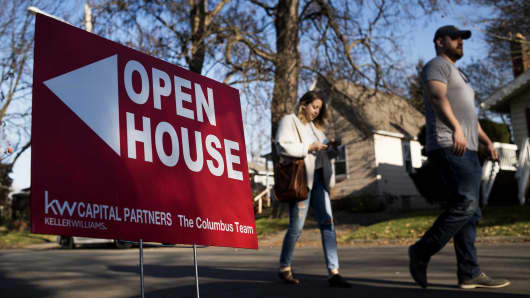


Potential home buyers walk past an 'Open House' sign displayed in the front yard of a property for sale in Columbus, Ohio, on Sunday, Dec. 3, 2017.
Ty Wright | Bloomberg | Getty Images
Potential home buyers walk past an 'Open House' sign displayed in the front yard of a property for sale in Columbus, Ohio, on Sunday, Dec. 3, 2017.
Pent-up demand from the holidays likely fueled the solid jump in mortgage applications last week.
Total application volume rose 8.3 percent during the first week of the year from the previous week, as mortgage rates held below year-ago levels, according to the seasonally adjusted Mortgage Bankers Association report.

Refinance applications led the charge, rising 11 percent from the previous week. Homeowners may be taking advantage of lower rates now, concerned that rates will move higher this year. Rates were higher at the start of 2017 than they are now. Homeowners also saw big gains in home equity last year and may be taking advantage of that in cash-out refinances.

The average contract interest rate for 30-year fixed-rate mortgages with conforming loan balances of $453,100 or less was basically unchanged during the week, increasing just 1 basis point to 4.23 percent, with points decreasing to 0.35 from 0.37, including the origination fee, for 80 percent loan-to-value ratio loans.

Economic news was mixed during the week, which kept interest rates in check.

"For example, the ISM's nonmanufacturing index showed that growth in the services sector was down for the second month, and the BLS' December jobs report was weaker than expected," said Joel Kan, an MBA economist. "However, these were partially offset by slightly stronger factory orders for November and continued optimism of positive impacts from the tax reform plan."

Homebuyers also came back to the market after the holiday break. Mortgage applications to purchase a home rose 5 percent for the week but were 1 percent lower than the same week one year ago.

"This was likely a catch-up week for potential borrowers as we head into the new year," Kan said.

Homebuyers this year are facing a new landscape on the tax front. The Republican tax plan reduced the deductions that homeowners can take for property taxes and mortgage interest. In higher-priced housing markets and in states with high property-tax rates, that makes homebuying more expensive than it was just a few weeks ago.

Buyers are also facing higher prices due to a severe lack of supply. More homes should begin to come on the market this month and next, with sellers hoping to get the jump on the spring market, especially those who are selling in order to buy another home. Unfortunately for buyers, there is so much demand for housing right now that any new supply will likely be swallowed up quickly with competition and prices remaining high.

Robert Bobby Darvish Platinum Lending Solutions Orange County california

Thursday, November 2, 2017

GOP tax plan would shrink mortgage interest benefit, slash corporate tax rate

GOP tax plan would shrink mortgage interest benefit, slash corporate tax rate

Play Video 2:34
What's in the House GOP tax plan?
Embed
Share
House Republican leaders on Thursday, Nov. 2 proposed legislation that would overhaul the U.S. tax code. Here's what you need to know about it. (Monica Akhtar/The Washington Post)
House Republican leaders on Thursday proposed legislation that would overhaul the U.S. tax code, slash corporate and individual income tax rates and jettison numerous tax breaks Americans and businesses have used for years to limit their tax bills.
The release of the proposal accelerates a frantic political effort that could impact almost every American household and business. In a number of cases, the tax plan cuts back on tax benefits for families and individuals while expanding tax benefits for companies.
The Tax Cuts and Jobs Act would lower the corporate tax rate from 35 percent to 20 percent and collapse the seven tax brackets paid by families and individuals down to four. It would create giant new benefits for the wealthy by cutting business taxes, eliminating the estate tax, and ending the alternative minimum tax.
The legislation would cut in half the popular mortgage interest deduction used by millions of American homeowners, changing the deduction’s rules for new mortgages. Presently, Americans can deduct interest payments made on their first $1 million worth of home loans. Under the bill, for new mortgages, they would only be able to deduct interest payments made on their first $500,000 worth of home loans.
This change could have a particularly big impact on high-cost areas, such as San Francisco, New York, Boston, and the Washington D.C. area, and housing groups and lawmakers will likely try to defeat it. The bill would allow people to deduct their local property taxes from their taxable income, though this benefit would be capped at $10,000.
Play Video 1:55
10 tax reform promises Trump has made
Embed
Share
A look at what President Trump has promised Americans as it relates to his tax reform plan. (Joyce Koh/The Washington Post)
The bill would nearly double the amount of money not subject to federal income tax, a tax break known as the “standard deduction.” Under the plan, that deduction would rise from $12,700 per family to $24,000. But this benefit would be partially offset by the personal exemption many Americans can claim, which can be large for families with multiple children.
The bill’s true impact on the middle class will be difficult to immediately measure. The bill would create a new “Family Credit” and expand the child tax credit used by working families. The child tax credit would grow from $1,000 per child to $1,600 for each child.
Families would also no longer be able to deduct their state income taxes from their federal taxable income, another change that would have a particular impact on places like New Jersey and New York, where state taxes are higher than in other areas. Taxpayers will be able to deduct their property taxes up to $10,000.
Americans would no longer be able to deduct their medical expenses or property and casualty losses, according to a document outlining the plan.
The legislative fight over the tax bill has become the Trump administration’s biggest political goal, after failed attempts to repeal the Affordable Care Act. Trump wants the legislation to pass the House and the Senate by the end of the year, though they must resolve numerous differences.
The bill would add $1.5 trillion to the debt over 10 years, but Republicans believe the changes would trigger a surge in economic growth, higher wages, and job creation.
Other changes in the bill would be far reaching. It would, for example, make changes to college savings programs and have new requirements for tax-exempt organizations like churches and charities.
The measure now moves into a contentious phase as Republican lawmakers look to make their preferred changes to the bill while nearly all Democrats work to block it, all while an army of lobbyists lean on Congress in a bid to protect their preferred deductions.
Robert Bobby Darvish Platinum Lending Solutions Orange County

Thursday, July 27, 2017

Mortgage rates slide lower as Fed considers unwinding its balance sheet


(Paul J. Richards/AFP/Getty Images)
Mortgage rates fell for the second week in a row ahead of the Federal Reserve’s July meeting.
According to the latest data released Thursday by Freddie Mac, the 30-year fixed-rate average slipped to 3.92 percent with an average 0.5 point. (Points are fees paid to a lender equal to 1 percent of the loan amount.) It was 3.96 percent a week ago and 3.48 percent a year ago.
The 15-year fixed-rate average dropped to 3.2 percent with an average 0.5 point. It was 3.23 percent a week ago and 2.78 percent a year ago. The five-year adjustable rate average fell to 3.18 percent with an average 0.5 point. It was 3.21 percent a week ago and 2.78 percent a year ago.
The Federal Reserve left its benchmark rate unchanged after its meeting this week but signaled that it would start rolling back its balance sheet “relatively soon.” The announcement came too late in the week to factor into Freddie Mac’s survey. The government-backed mortgage-backer aggregates current rates weekly from 125 lenders from across the country to come up with national average mortgage rates.
Any shrinking of the central bank’s $4.5 trillion portfolio is likely going to have an impact on mortgage rates. The Fed has said it would reduce its holdings gradually, but too quick of a sell-off could send rates skyrocketing. Back in 2013 when then-Fed chairman Ben Bernanke testified before Congress about tapering the bond-buying program, the “taper tantrum” fueled a rapid rise in rates.
Michael Fratantoni, Mortgage Bankers Association chief economist, expects the Fed to announce in September that it will begin unwinding its balance sheet in October. He also predicts another rate increase later this year.
“The job market is tight,” Fratantoni said. “Many employers are finding it increasingly challenging to fill open positions. And yet wage growth and price inflation remain low. We agree with the Fed’s expectation that inflation will increase later this year and into next, and this will prompt further increases in the Fed’s short-term target, with the next hike most likely coming in December.”
Despite the news out of the Fed, most of the experts surveyed by Bankrate.com, which puts out a weekly mortgage rate trend index, say rates will remain relatively stable in the coming week.
“Even with the dial back on their balance sheet beginning ‘relatively soon,’ the Fed’s concerns about low inflation will keep a lid on mortgage rates for now,” said Greg McBride, chief financial analyst at Bankrate.com.
Meanwhile, mortgage applications were flat last week, according to the latest data from the Mortgage Bankers Association. The market composite index — a measure of total loan application volume — increased 0.4 percent. The refinance index rose 3 percent, while the purchase index fell 2 percent.
The refinance share of mortgage activity accounted for 46 percent of all applications.

Friday, May 12, 2017

Mortgage rates edge higher but remain within a narrow band

Mortgage rates edge higher but remain within a narrow band

 
Mortgage rates wandered higher again this week after a brief slip but remain within a narrow band.
According to the latest data released Thursday by Freddie Mac, the 30-year fixed-rate average ticked up to 4.05 percent with an average 0.5 point. (Points are fees paid to a lender equal to 1 percent of the loan amount.) It was 4.02 percent a week ago and 3.57 percent a year ago. The 30-year average has hovered between 4.02 percent and 4.05 percent the past three weeks.
“Mixed economic reports over the last few weeks have anchored the 30-year mortgage rate around the 4 percent mark,” Sean Becketti, Freddie Mac chief economist, said in a statement.
The 15-year fixed-rate average rose to 3.29 percent with an average 0.5 point. It was 3.27 percent a week ago and 2.81 percent a year ago. The five-year adjustable rate average increased to 3.14 percent with an average 0.5 point. It was 3.13 percent a week ago and 2.78 percent a year ago.
With the yield on the 10-year Treasury climbing to 2.42 percent Tuesday, its highest point since March 30, home loan rates — which tend to follow the movement of long-term bonds — were slowing moving higher. Then came the unexpected firing of FBI Director James B. Comey. Because this type of news makes investors anxious and causes them to seek safety in bonds, the yield on the 10-year U.S. bond slid to 2.41 percent Wednesday.
The retreat in long-term bond yields came too late in the week to be factored into Freddie Mac’s survey. The government-backed mortgage-backer aggregates rates weekly from 125 lenders from across the country to come up with a national home loan rate average.
Experts are mixed on where mortgage rates are headed. Rates had fallen in 6 of the past 7 weeks. Bankrate.com, which puts out a weekly mortgage rate trend index, found that about half of the experts it surveyed say rates will go up and another half say they will remain relatively stable in the coming week. Less than 10 percent say they will fall. Greg McBride, chief financial analyst for Bankrate.com, is one who expects rates to rise.
“The job market is tightening, inflation is moving up, and the Fed is poised to raise rates in June — all of which is providing some lift to mortgage rates,” McBride said.
Meanwhile, mortgage applications picked up last week, according to the latest data from the Mortgage Bankers Association. The market composite index — a measure of total loan application volume — increased 2.4 percent. The refinance index rose 3 percent, while the purchase index grew 2 percent to its highest level since October 2015.
The refinance share of mortgage activity accounted for 41.9 percent of all applications.

Robert Bobby Darvish platinum Lending Solutions of Orange County

Tuesday, April 4, 2017

Why We Could Get Negative Interest Rates Even Though The Fed Is Hiking

Why We Could Get Negative Interest Rates Even Though The Fed Is Hiking


Federal Reserve Board Chairman Janet Yellen speaks during a briefing on March 15, 2017 in Washington, DC. / AFP PHOTO / Brendan Smialowski/Getty Images
At its March meeting, the Federal Reserve raised interest rates by 0.25%. In doing so, it hiked rates for only the third time since 2006. However, in a strange turn of events, the Fed’s move was perceived as a dovish one by the markets.
That’s because even with inflation at its highest level since 2012, the Fed said monetary policy will remain accommodative for some time. As has been the case in the past, the Fed is willing to let inflation consolidate above its 2% target before embarking on a more aggressive tightening path.
This willingness to let inflation run hot means even as nominal rates rise, real ratesthat is, the nominal interest rate minus inflationare headed into negative territory.
So what are the implications of negative real rates?
Negative Real Rates Drive Gold Higher
The consumer price index (CPI), the most widely used measure of inflation, averaged 2.67% for the first two months of the year. Even if inflation averaged only 2% for all of 2017the Fed’s targetit would be a big problem for investors and savers alike.
Today, a one-year bank CD pays about 1.4%. Therefore, anyone who keeps their money in a bank is watching their purchasing power erode.
Of course, there are other options. You can put your money in U.S. Treasuries or dividend-paying stocksboth popular sources of fixed income.
However, with both the 10-year Treasury yield and the average dividend yield for a company on the S&P 500 hovering around 2.35%, that doesn’t leave much in the way of real gains if inflation is running at 2% per annum.
If inflation rises or bond yields fall, real interest rates will be pushed into the red… and that’s very bullish for gold.
Gold is known as the yellow metal with no yield, but simple math tells us no yield is better than a negative one. Because of this, gold has done well when real rates are in negative territory. In fact, real US interest rates are a major determinate of which direction the price of gold moves in.
A study from the National Bureau of Economic Research found that from 1997–2012, the correlation between real U.S. interest rates and the gold price was -0.82.
This means as real rates rise, the price of gold falls and vice versa. A -1.0 reading would be a perfect negative correlation, so this is a tight relationship.

The Fed’s hesitation to raise rates faster is contributing to another trend that is also bullish for gold.
A Falling Dollar Equals Higher Gold Prices
In the six weeks following the US election, the dollar skyrocketed 5.6%a huge move for a currency.
However, since the beginning of the year, the greenback has given back most of its post-election gains. This is in part due to the Fed’s dovishness on interest rates.
The strong negative correlation between gold and the U.S. dollar is a major reason the yellow metal is up over 9% year to date.
Market Realist
Market Realist
In the March edition of Bank of America Merrill Lynch’s Global Fund Manager Survey, respondents thought the dollar was at its most overvalued level since 2006. As the chart shows, the survey has a good track record of determining when the dollar is overvalued.
Bank of America Merrill Lynch
Tying it all together, what do these trends mean for gold?
Gold Should Go Higher from Here
With arguably the two biggest drivers of the gold price trending in the yellow metals favor, gold is likely to go higher. Although the dollar could rise if Washington implements some structural reform, real rates aren’t headed higher anytime soon based on the Fed’s actions.
Bank of America Merrill Lynch said these two trends were part of the reason why it upgraded its forecast for gold to $1,400 per oz. by year-end. As the chart below shows, the market turned bullish on gold following the Fed’s December rate hike.
In closing, after nine years of doing its utmost to generate inflation, the Fed has finally succeeded. If past is prologue, as inflation rises over the coming months, gold will do very well.
If you’re considering getting some gold before it goes up, do your homework first.

Robert Bobby Darvish Platinum Lending Solutions

Friday, February 24, 2017

Mortgage rates move lower for Friday Feb 24 2017

Mortgage rates move lower for Friday


Several key mortgage rates dropped today. The average rates on 30-year fixed and 15-year fixed mortgages both decreased. On the variable-mortgage side, the average rate on 5/1 adjustable-rate mortgages also fell.
Mortgage rates are in a constant state of flux, but, overall, they are very low by historical standards. If you're in the market for a mortgage, it may be a great time to lock in a rate. Just make sure you shop around first.
RATE SEARCH: Compare mortgage rates in your area now.

30-year fixed mortgages

The average rate you'll pay for a 30-year fixed mortgage is 3.97 percent, down 7 basis points
over the last week. A month ago, the average rate on a 30-year fixed mortgage was higher, at 4.09 percent.
At the current average rate, you'll pay a combined $475.69 per month in principal and interest for every $100,000 you borrow. That's a decline of $4.03 from last week.
You can use Bankrate's mortgage calculator to estimate your monthly payments and see how much you'll save by adding extra payments. It will also help you calculate how much interest you'll pay over the life of the loan.

15-year fixed mortgages

The average 15-year fixed-mortgage rate is 3.16 percent, down 2 basis points
over the last seven days.
Monthly payments on a 15-year fixed mortgage at that rate will cost around $698 per $100,000 borrowed. The bigger payment may be a little more difficult to find room for in your monthly budget than a 30-year mortgage payment would, but it comes with some big advantages: You'll come out several thousand dollars ahead over the life of the loan in total interest paid and build equity much more quickly.

5/1 ARMs

The average rate on a 5/1 ARM is 3.15 percent, falling 1 basis point from a week ago.
These types of loans are best for those who expect to sell or refinance before the first or second adjustment. Rates could be substantially higher when the loan first adjusts, and thereafter.
Monthly payments on a 5/1 ARM at 3.15 percent would cost about $430 for each $100,000 borrowed over the initial five years, but could increase by hundreds of dollars afterward, depending on the loan's terms.

Where rates are headed

To see where Bankrate's panel of experts expect rates to go from here, check out our Rate Trend Index.
RATE SEARCH: Want to see where rates are right now? See local mortgage rates.
Average mortgage rates
Product Rate Change Last week
30-year fixed 3.97% 0.07 4.04%
15-year fixed 3.16% 0.02 3.18%
30-year fixed jumbo 4.46% 0.16 4.30%
30-year fixed refinance 3.99% 0.09 4.08%
Last updated: February 24, 2017.
Methodology: The rates you see above are Bankrate.com Site Averages. These calculations are run after the close of the previous business day and include rates and/or yields we have collected that day for a specific banking product. Bankrate.com site averages tend to be volatile -- they help consumers see the movement of rates day to day. The institutions included in the "Bankrate.com Site Average" tables will be different from one day to the next, depending on which institutions' rates we gather on a particular day for presentation on the site.
To learn more about the different rate averages Bankrate publishes, see "Understanding Bankrate's Rate Averages."

Bobby Robert Darvish Platinum Lending Solutions Orange County

Thursday, January 19, 2017

How a one-two, Trump-Yellen punch may move interest rates

How a one-two, Trump-Yellen punch may move interest rates


Sergey Lipinets, (blue gloves) from Moscow, Russia, during his IBF Junior Welterweight Bout against Lenny Zappavigna, (red gloves) from New South Wales, Australia, at the Galen Center at the University of Southern California on December 10, 2016 in Los Ang
Jayne Kamin-Oncea | Getty Images
Interest rates could try recent highs on the potent combination of a hawkish Janet Yellen and the pro-growth talk that is likely to come from Donald Trump in the next couple days.
Trump will be sworn in as 45th U.S. president on Friday, and the markets are looking for him to play up his pledges to push forward tax breaks and infrastructure spending early in his administration. He may also take actions in his first days that reduce regulation and define his commitment to the promises he's made voters. That could be seen as a near-term negative for Treasury prices and would send yields higher.
Already, bond yields were on the rise Thursday, lifted by surprising remarks from Fed Chair Yellen on Wednesday afternoon and economic reports Thursday morning showing decades-low jobless claims, an 11.3 percent jump in housing starts and a two-year high in mid-Atlantic manufacturing activity. Also a factor was the Wednesday report of a jump in headline consumer price index inflation to a more than two-year high of 2.1 percent year over year in December.
"I don't think we're going to see a huge surge in optimism again. We're not going to get another leg off of it, but I also don't think we're going to go back to where we were in October." -Tom Simons, money market economist, Jefferies
In her comments, Yellen said she expects a few rate hikes this year and that the fed funds target rate could get to 3 percent by 2019 — all in line with the Fed's forecasts. But it was Yellen's seemingly confident embrace of those targets that got the market's attention. Markets had been skeptical of the Fed forecast, and many economists had expected just two rate increases this year, not the three in the central bank's projection.
"She certainly gave the market a big push. Just looking at March probabilities, they went from an 18 percent chance (of a rate hike) to 25," said Aaron Kohli, rate strategist at BMO. "The market went from pricing slightly less than two hikes to slightly more than two hikes in 2017." He said expectations in the fed funds futures for a June rate rise went to 93 percent from 85 percent after Yellen spoke.
The 10-year Treasury yield also snapped to 2.43 percent after Yellen spoke and was as high as 2.48 percent Thursday, its highest level since Jan. 3. The two-year yield rose as well, but the curve flattened, meaning the gap between two-year yields and 10-year yields narrowed. The two-year was as high as 1.25 percent Thursday.
Yellen was scheduled to speak again and take questions Thursday evening at 8 p.m. ET at a Stanford University event. The Fed next meets Feb. 1 and while it is not expected to take action, the gathering could result in some more hawkish talk.
Kohli said the next target for the 10-year would be 2.52 percent, and then 2.60 percent.
"After the weekend and Monday, it's going to be very interesting. What happens when we get to brass tacks will be interesting for sure." -Tom Simons, money market economist, Jefferies
The bond market has been consolidating for the past several weeks after the 10-year reached a postelection high of 2.64 percent on Dec. 15. That is the level that could be tested in the near future, strategists say.
"There's a short base that will get even bolder if rates get to that level," Kohli said, adding short bets could add to the growing position sending rates higher. "I think it's very possible you get that kind of spike up. What I would suggest is as soon as that happens you might go the other way."
Money market economist Tom Simons at investment banking firm Jefferies said he doesn't see a big move in yields, but the bias should be toward higher yields, and lower prices. "I don't think we're going to see a huge surge in optimism again. We're not going to get another leg off of it, but I also don't think we're going to go back to where we were in October," he said.
"Next week we'll have two-, five- and seven-year auctions, a little bit of supply, and a light data week, so the focus is going to be on Trump, and for the most part, the first stuff that comes out of the gate is probably going to be (bond) market negative and it will be risk positive," he said.
Simons said he thought the rally in Treasurys, which drove the 10-year yield toward 2.30 percent earlier this week, was overdone.

In the last several weeks, yields fell as investors became disillusioned with the "Trump trade" and the prospects for quick adoption of the president-elect's pro-growth agenda.
Trump did talk up expectations for a tax program or stimulus when he met with the press last week, and that absence raised flags about what he will get done early in his administration. Trump's focus on repealing Obamacare and his comments on tariffs both were concerns for the market, since the issue of altering America's health-care system is seen as a quagmire, while tariffs could spark a trade war.
"After the weekend and Monday, it's going to be very interesting. What happens when we get to brass tacks will be interesting for sure," said Simons.
Kohli said he expects Trump to focus on infrastructure spending and tax cuts. He could make a bigger splash in markets if he announces fiscal spending that can be put to work right away. Tax reform and cuts are also important, but Kohli said that's likely months away.
Strategists expect Trump to push forward quickly on initiatives in his first weeks, and markets will be disappointed if he doesn't. "If he squanders it, that's his downside," said Kohli.

Robert Bobby Darvish Platinum Lending Solutions

Thursday, January 12, 2017

Average US 30-Year Mortgage Rate Falls to 4.12 Percent


Long-term US mortgage rates fell this week, the second week of declines after snapping a nine-week run of increases.
Mortgage buyer Freddie Mac said Thursday the rate on 30-year fixed-rate loans eased to an average 4.12 percent from 4.20 percent last week. That was still sharply higher than a 30-year rate that averaged 3.65 percent for all of 2016, the lowest level recorded from records going back to 1971. A year ago, the benchmark rate stood at 3.92 percent.
The average for a 15-year mortgage declined to 3.37 percent from 3.44 percent last week.
Mortgage rates surged in the weeks since the election of Donald Trump in early November. Investors in Treasury bonds bid yield rates higher because they believe the president-elect's plans for tax cuts and higher spending on roads, bridges and airports will drive up economic growth and inflation.
That would depress prices of long-term Treasury bonds because inflation would erode their value over time, a prospect that caused investors to demand higher yields.
In the latest week, a report from the government on employment in December pushed the price of the 10-year Treasury bond higher, dampening its yield. The Labor Department report issued last Friday showed that U.S. employers added 156,000 jobs last month, capping a year of slower but solid hiring.
Though the unemployment rate rose to 4.7 percent from a nine-year low of 4.6 percent, it did so for an encouraging reason: More people began looking for work. Because not all of them found jobs immediately, more people were counted as unemployed in December.
Bond yields move opposite to prices and influence long-term mortgage rates. The yield on the 10-year Treasury bond fell to 2.37 percent Wednesday from 2.44 percent a week earlier. That compares with 1.87 percent on Election Day Nov. 8. The yield declined further to 2.33 percent Thursday morning.
To calculate average mortgage rates, Freddie Mac surveys lenders across the country between Monday and Wednesday each week. The average doesn't include extra fees, known as points, which most borrowers must pay to get the lowest rates. One point equals 1 percent of the loan amount.
The average fee for a 30-year mortgage was unchanged this week at 0.5 point. The fee on 15-year loans also remained at 0.5 point.
Rates on adjustable five-year loans fell to 3.23 percent from 3.33 percent. The fee increased to 0.5 point from 0.4 point.

Robert Bobby Darvish of Platinum Lending Solutions
 

Tuesday, December 20, 2016

Why you shouldn't panic about rising mortgage rates

Why you shouldn't panic about rising mortgage rates


Mortgage rates have been on a steady rise recently, but buyers shouldn't panic -- rates are still very low.

The average rate for a 30-year fixed-rate mortgage rose to 4.16%, up from 4.13% last week, according to Freddie Mac. A year ago, rates were sitting around 3.97%.

At the current interest rates, buyers will pay $21 more per month compared to a year ago, assuming a $241,000 price tag and 20% down payment.

"I don't think anyone welcomes higher interest rates, but it should not be a considerable deterrent to someone who really wants to buy a home," said Keith Gumbinger, vice president of HSH.com.
Rates under 5% have been the norm for a decade. "We still have quite a ways to go for rates to be even close to average," noted Len Kiefer, deputy chief economist for Freddie Mac.
In 1996, the average rate was 5.67%, and in 1990 it was 10.13%.
Related: Mnuchin wants U.S. to sell Fannie Mae, Freddie Mac stakes
Rising home prices, fueled by strong demand and tight inventory, have pinched buyers in recent years. Lower interest rates helped temper that rise, but as they move higher, borrowing becomes more costly and can reduce a buyer's budget.
"If rates remain at this level, some marginal buyers could be pushed out of the marketplace," said Gumbinger. "There could be less demand for properties on the margin, but I don't think there will be a huge change."
Kiefer said he expects home prices to continue to rise in 2017 year, but at a slower pace than we saw this year. "The supply is pretty low compared to demand and that will keep pressure on prices and rents."
The rate increases could be felt more by house hunters in the country's more expensive markets, like San Francisco and Manhattan.
"Affordability is already difficult in some markets," said Erin Lantz, vice president of mortgages for Zillow. "Rates can have more of an impact in those areas, but for most of the country, it's still very affordable, by historical standards"
Mortgage loan applications dropped 4% last week, according to the Mortgage Bankers Association.
Experts forecast rates will continue to gradually increase throughout 2017, particularly after the Federal Reserve increased a key interest rate on Wednesday for the second time in 10 years.
A higher Federal Funds rate makes it more expensive for banks to borrow money, which can lead to higher rates on credit cards and home loans.
Related: What a Fed rate hike means for you
"The era of ultra-low interest rates is over," said Lawrence Yun, chief economist of the National Association of Realtors, in a statement Wednesday. "[The] short-term rate hike will be followed by several additional rounds of increases in 2017 and 2018. Despite these moves, mortgage rates will not rise alarmingly."
The bond market also plays a role in mortgage rates. Interest rates on the U.S. government's 10-year Treasury note have been on a tear since Donald Trump was elected president. Treasury notes are a benchmark for many types of credit, including home loans.
Other factors -- like global economic uncertainty -- also affect U.S. mortgage rates.
"Global markets have sneezed and hiccupped and gone crazy at times and have driven down our interest rates," said Gumbinger.
For instance, after the Brexit vote in June, the rate on a 30-year fixed rate mortgage dropped to 3.48% -- the lowest level since May 2013.
As rates move higher, we could see the return of more home loan products, like adjustable rate mortgages.
"Non-traditional mortgage products could start to creep back into the market as consumers search for more affordable options," said Lantz.

Sunday, November 6, 2016

Mortgage Rates Inch Up; Solid Jobs Report Is Consistent With a December Rate Rise

Mortgage rates inched ahead on Friday; meanwhile, 161,000 jobs added in October and advancing hourly wages are consistent with a December rate rise from the Fed.

Nov 4, 2016 at 2:19PM
House For Sale
IMAGE SOURCE: PIXABAY.
Mortgage rates inched up on Friday: The average 30-year mortgage rate is 3.49%, which equates to a $448.49 monthly payment per $100,000 borrowed. A month ago, the equivalent payment would have been lower by $7.22.
If you opt for a shorter term, the average 15-year mortgage rate is 2.74%, which equates to a $678.15 monthly payment per $100,000 borrowed. A month ago, the equivalent payment would have been lower by $5.22.
Rate (national average)
Today
1 Month Ago
30-year fixed jumbo
4.13%
4.35%
30-year fixed
3.49%
3.36%
15-year fixed
2.74%
2.63%
30-year fixed refi
3.52%
3.41%
15-year fixed refi
2.77%
2.65%
5/1 ARM
3.04%
2.92%
5/1 ARM refi
3.17%
3.02%
5/1 ARM = ADJUSTABLE-RATE MORTGAGE WITH AN INITIAL FIXED FIVE-YEAR INTEREST RATE. DATA SOURCE: BLOOMBERG.

Strong October jobs report sets up a December rate hike, but expect rate rises to be gradual

The employment situation report for the month of October was well-received on Friday. The addition of 161,000 jobs to nonfarm payrolls was within Bloomberg's range of estimates of 155,000 to 200,000. That figure was bolstered with upward revisions for August and September totaling 44,000. The unemployment rate fell to 4.9% in October, from 5%, in line with the consensus estimate. Most noteworthy, perhaps, were average hourly earnings, which rose by 0.4%, above the 0.2% to 0.3% range of estimates.
Despite these results, the market-implied probability of a December interest-rate rise fell from 78% to 74% on Friday, according to data from Bloomberg. The probabilities are derived from prices in the federal funds futures market.
Speaking at the 2016 Realtors Conference and Expo this morning, Federal Reserve Bank of Atlanta president Dennis Lockhart said of this morning's report, "the top-line numbers look solid." He went on to say:
I anticipate a very gradually rising interest rate environment over the next two years. ... And when the rate environment does reach steady state, mortgage rates should still be low and affordable by historical standards.
Mr. Lockhart is not a member of the Fed's interest rate-setting committee.
The interest-rate cycle is turning, but the turn will likely be very gradual, which is good news for prospective homebuyers.
The $15,834 Social Security bonus you could be missing
If you're like most Americans, you're a few years (or more) behind on your retirement savings. But a handful of little-known "Social Security secrets" could help ensure a boost in your retirement income. For example: one easy trick could pay you as much as $15,834 more... each year! Once you learn how to maximize your Social Security benefits, we think you could retire confidently with the peace of mind we're all after. Simply click here to discover how to learn more about these strategies.
Try any of our Foolish newsletter services free for 30 days. We Fools may not all hold the same opinions, but we all believe that considering a diverse range of insights makes us better investors. The Motley Fool has a disclosure policy.

Sunday, October 23, 2016

Mortgage Rates Just Hit a 4-Month High

It’s returning to pre-Brexit levels.

Interest rates on U.S. 30-year mortgages rose to their highest levels in four months in line with rising Treasury yields on a bond market sell-off spurred by speculation about reduced stimulus from global central banks, mortgage finance agencyFreddie Mac said on Thursday.
The average 30-year mortgage rate was 3.52% in the week ended Oct. 20, Freddie Mac said in its latest mortgage rate survey. This was the highest level since the 3.56% recorded in the week of June 23.
“This is the first week in over four months that rates have risen above 3.50%. This month, mortgage rates seem to be catching up to Treasury yields and returning to pre-Brexit levels,” Sean Becketti, Freddie Mac’s chief economist, said in a statement.
Benchmark 10-year Treasury yields were at 1.74% early on Thursday, down more than 1 basis point (a tenth of a percentage point) on the day. On Monday, it reached 1.81%, which was its highest since June 2, Reuters data showed.

Sunday, October 16, 2016

Fed may have to hike interest rates faster, Rosengren says

Boston Fed president sees unemployment rate dropping to 4.5% next year

Bloomberg News/Landov
Federal Reserve Bank of Boston President Eric Rosengren
The Federal Reserve may have to be more aggressive in raising interest rates than the measured pace it currently projects, Boston Fed President Eric Rosengren said on Friday.
The Fed’s latest economic forecast sees interest rates a little above 1% by the end of next year and just under 2% in 2018.
“My own view is that if the unemployment rate falls as much as I’m expecting, then it is possible that we’ll have to raise rates faster than the summary of economic projections,” Rosengren said in an interview with CNBC.
The Boston Fed president was one of three dissenters at the September Fed meeting, wanting the central bank to lift interest rates by a quarter percentage point.
Rosengren said he thinks the unemployment rate will drop to around 4.5% by next year. He said he was concerned this was unsustainable, and may force the Fed to hike rates much more quickly than he hoped would be needed.
The Boston Fed president said some new research has cast doubt on whether disaffected workers will continue to return to the labor force and keep the unemployment rate from falling.
Traders have priced in a small chance that the Fed will move at its next meeting on Nov. 1-2 given that it is six days from the presidential election. At the same time, investors have priced in a greater than 60% chance of a rate hike at the Fed’s December meeting, when Fed Chairwoman Janet Yellen is scheduled to hold a press conference.
“To me that seems quite appropriate,” Rosengren said Friday. “We have tended to move around the time the Fed chair has a press conference,” he added.
Read: Fed hold rates steady for the time being
Rosengren noted in the interview that his outlook for the pace of interest rate hikes is also faster than the market has priced in.
He said he was concerned that the 10-year Treasury rate TMUBMUSD10Y, -0.39%  and the commercial real estate capitalization rate are at historic lows. The 10-year rate “is roughly at where we think inflation is right now. It is quite a low rate,” he said.
This low rate suggests investors have no confidence in the Fed’s ability to offset weak growth, the Boston Fed president said.
“So the fact that long rates are so low, and that there are some sectors of the economy that we’re starting to see very rapid asset growth—like commercial real estate, is a source of concern as people start moving to try to get higher returns because we’ve had low rates for a long period of time,” he said.
The Fed could use its balance sheet to steepen the yield curve if one was worried about potential financial stability concerns from these low rates, he said.
“If one were concerned about the historically low 10-year Treasury and commercial real estate capitalization rates, perhaps because of potential financial stability concerns, the balance sheet composition could be adjusted to steepen the yield curve,” he said.
This suggests that Rosengren is in favor of using the balance sheet as a tool for policy, either buying or selling securities to raise long-term rates.
The Boston Fed president did not elaborate on his comment. Most Fed officials have come out in active use of the $4 trillion balance sheet. They have supported a plan to gradually let the balance sheet shrink but not until short-term interest rates are about 1% and the expansion is on firmer ground.
In her recent speech on the Fed’s policy tools in Jackson Hole, Yellen said uncertainty and potential costs caused the Fed to decide against using the balance sheet

Monday, September 5, 2016

Trump says U.S. interest rates must change as Fed weighs rate hike

By Steve Holland | YOUNGSTOWN, OHIO
Republican presidential nominee Donald Trump, who has previously accused the Federal Reserve of keeping interest rates low to help President Barack Obama, said on Monday that the U.S. central bank has created a "false economy" and that interest rates should change."They're keeping the rates down so that everything else doesn't go down," Trump said in response to a reporter's request to address a potential rate hike by the Federal Reserve in September. "We have a very false economy," he said.
"At some point the rates are going to have to change," Trump, who was campaigning in Ohio on Monday, added. "The only thing that is strong is the artificial stock market," he said.

Fed Chair Janet Yellen said last month that the U.S. central bank was getting closer to raising interest rates, possibly as early as September, saying that the Fed sees the economy as close to meeting its goals of maximum employment and stable prices. The Fed raised interest rates last December for the first time in nearly a decade, and at that time projected four more hikes in 2016. The Fed later scaled back that projection to two rate hikes this year in the wake of a slowdown in global growth and continued financial market volatility.
Trump, during the primary campaign, as he took on 16 Republican rivals, had called Yellen's tenure "highly political" and said the Fed should raise interest rates but would not do so for "political reasons."
The Fed has been a target of some conservative critics in the U.S. Congress, who say the bank risked sparking inflation with its easy monetary policies in response to the global financial crisis.
Fed officials say their independence is critical to making sound policy decisions.
(Reporting by Steve Holland in Youngstown; Additional reporting and writing by Amanda Becker in Washington; Editing by Leslie Adler)
Brought to you by Robert Bobby Darvish, Platinum Lending Solutions

Sunday, August 28, 2016

Fed’s Dislike of Negative Interest Rates Points to Limits of Stimulus Measures

Federal Reserve officials are content to watch others’ experience of negative rates from a distance 

Federal Reserve Chairwoman Janet Yellen arrives for a reception on the opening night of the annual meeting of the world's central bankers at Jackson Lake Lodge in Grand Teton National Park, north of Jackson Hole, Wyo., on Thursday.
Federal Reserve Chairwoman Janet Yellen arrives for a reception on the opening night of the annual meeting of the world's central bankers at Jackson Lake Lodge in Grand Teton National Park, north of Jackson Hole, Wyo., on Thursday. Photo: Associated Press
JACKSON HOLE, Wyo.—Federal Reserve officials are turning a cold shoulder to a controversial idea being tried in Japan and much of Europe to boost anemic economies: negative interest rates.
Fed officials don’t think negative rates are needed in the U.S. because the economy and job market are improving, and they are hoping they will never have to use them in the future given their uncertainty about whether the policy works.

Fed Chairwoman Janet Yellen didn’t even mention the idea in a discussion of the Fed’s options for the economy should recession hit the U.S., and other officials speaking on the sidelines of the Fed’s annual retreat here over the weekend made clear it is an approach they would like to avoid.
–– ADVERTISEMENT ––
“I’m treating [negative rates] as an experiment that we have the luxury to watch from a distance,” Dennis Lockhart, president of the Federal Reserve Bank of Atlanta, said in an interview at the Fed’s annual Jackson Hole conference in the Wyoming mountains.
The Fed’s aversion to negative rates shows how central bankers are confronting the limits of their efforts to stimulate the slow-growing global economy.
Negative rates are like a central bank’s version of the children’s game of hot potato—the potato being money nobody wants to get left holding. Commercial banks are charged for leaving funds on deposit with the central bank. By imposing a cost on parking money safely there, the policy aims to induce banks to lend their money elsewhere, to consumers and businesses, where they can earn higher returns. That risk-taking, in turn, is meant to spur economic growth.
Central banks in Japan, the eurozone, Denmark, Sweden and Switzerland have adopted negative rates with mixed effects. The Swiss National Bank ’s policy rate is -0.75%, the Bank of Japan ’s is -0.1% and ECB’s is -0.4%.

Negative rates are highly unpopular in many places because households are unhappy they earn such low returns on their savings and banks worry it squeezes their profit margins.
Subzero rates also have had some unintended effects. In Japan, negative rates were accompanied by a rising currency, the opposite of the central bank’s expectation.
In Switzerland, banks responded to negative rates by making mortgage borrowing more expensive and not less as hoped. Consumers are saving more in Germany, Japan, Sweden, Switzerland and Denmark, even though the aim is to prod consumers to save less and spend more.
Still, central bankers here said negative rates showed signs of working in many of their intended ways.

Yields on 30-year Japanese government bonds dropped from about 1.5% before Japan adopted negative rates in January to less than 0.5%. That could in turn drive borrowing, spending and investing in Japan, as intended.
“Declines in long-term borrowing costs have stimulated firms’ demand for long-term funding and households’ demand for mortgage loans, thereby benefiting a wide range of borrowers,” BOJ Governor Haruhiko Kuroda said here. “A significant increase in issuance of corporate bonds with a maturity of 20 years or even longer has been observed.”

European Central Bank data released this week showed loans to households were up 1.8% from a year earlier in July and loans to nonfinancial corporations up 1.9%. That is modest but still reverses a contraction in lending in the months before negative rates were introduced.
Some worry that negative rates squeeze bank profits. However net income at European banks rose to 51 billion euros in 2015, compared with 31 billion in 2014, according to the ECB.
“Negative rates work and are nothing extraordinary or immoral or absurd,” European Central Bank executive board member Benoît Coeuré said of the eurozone’s experience of negative interest rates so far. Still, speaking to the lingering trepidation about the policy among central bankers here, he said he is cautious about pushing rates “to much deeper negative levels .”
 
At a panel here, academics wondered whether central banks could push interest rates more deeply into negative territory by doing away with cash or imposing costs on households holding it. Cash is an impediment to imposing negative interest rates. Households and businesses can hoard it to avoid paying the penalties imposed when depositing funds in banks.
Central bankers here were reluctant to embrace the idea of pushing the policy much further, even as they defended its effects.

“There are many outstanding issues,” Marianne Nessén, who heads the Swedish central bank’s monetary policy department, said during a discussion at Jackson Hole. “Even if the experience with mildly negative interest rates has been roughly as expected, I’m not sure that we conclude that deeply negative interest rates will work in the same manner.”
“At the heart of all this lies concerns that future growth prospects are lower than we have seen in the past decades, but the remedy for that does not lie with monetary policy. It must be found elsewhere,” she said.

One growing source of uncertainty is the effect of negative rates on household saving behavior. Low and negative rates aim to induce households to spend, but critics of these policies say the effect is the opposite. People who are trying to stockpile funds for retirement might be induced to save even more if the funds they’ve got are bleeding returns.

“The idea that low interest rates are punishing savers is a very ripe issue,” said James Bullard, St. Louis Fed president. “Everyone is doing a lot of soul-searching about these issues.”
For now the Fed doesn’t need to contemplate negative rates because the U.S. economy is improving and officials are looking to gradually raise rates from exceptionally low levels.
Ms. Yellen in her talk Friday sought to lay out a roadmap for how the Fed will proceed the next time there is an economic downturn and it turns back to rate cuts to stimulate growth.
She said the Fed would seek to lean on tools it used during the postcrisis period. This includes purchases of Treasury or mortgage bonds to drive long-term interest rates lower. Ms. Yellen suggested the Fed might even expand its purchases beyond these conventional investments. The Fed would also turn to assurances that rates will stay very low far into the future, she said.
On negative rates Ms. Yellen was silent.