This week we update you on what happened last week with the economy and how it will impact the markets this week. We also share some of the stocks we are eyeing between now and Friday the1st of July:
Monday, June 27, 2022

Friday, June 24, 2022
2022 State of the Nation’s Housing Market
An excellent comprehensive but yet simplified video featuring the 2022 state of the nation housing market by Harvard Joint Center of Housing:
Wednesday, June 22, 2022
Record price increase cools off
After a record-shattering year in 2021, the housing market is at an inflection point. Higher interest rates have taken some heat out of the homebuying market, and the large number of apartments under construction should bring some relief on the rental side. For lower-income households and households of color, though, the pressure of high housing costs is unlikely to relent. According to our new The State of the Nation’s Housing 2022 report, the surge in the prices of gas, food, and other necessities has made matters worse, especially now that most pandemic emergency government supports have ended.
The Soaring Costs of Housing
The costs of housing continue to climb. Home price appreciation nationwide hit 20.6 percent in March 2022, marking the largest jump in three decades, and is continuing to rise. The runup has been widespread, with 67 of the top 100 housing markets experiencing record-high appreciation rates. [INTERACTIVE CHART] Meanwhile, rents were up 12 percent in the first quarter of 2022, with increases in several metro areas exceeding 20 percent.
High Hurdles for First-Time Homebuyers
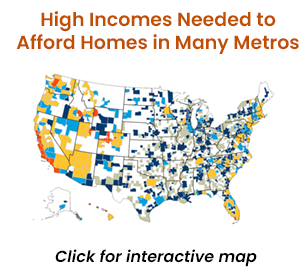 With interest rates rising, on top of double-digit home price increases, the income and savings needed to qualify for a home loan have skyrocketed. Potential homebuyers saw monthly mortgage payments on the median-priced US home rise by more than $600 over the past year. At today’s prices, the typical downpayment that a first-time buyer would need for a median-priced home is $27,400, which would rule out 92 percent of renters, whose median savings are just $1,500.
Increasing Inequalities
The massive windfall from rapid home price appreciation has widened the wealth gap between homeowners and renters. In 2019, the median wealth of homeowner households was $254,900—about 40 times the $6,270 median wealth for renter households. Because of their relatively low homeownership rates, many Black and Hispanic households missed out on these equity gains.
Persistent Affordability Challenges
Job and income losses early in the pandemic increased the affordability challenges for millions of households who were already struggling. In 2020, the share of households paying over a third of their income for housing climbed 1.5 percentage points to 30 percent. [INTERACTIVE CHART] This includes a 2.6 percentage point jump in the rate for renters and a 1.0 percentage point increase in the rate for homeowners. The increase among Black households was also disproportionately large at 2.4 percentage points.
Housing Construction at a New High
Residential construction has finally picked up: single-family starts hit 1.1 million in 2021, exceeding the million-unit mark for the first time in 13 years. Multifamily starts were also at a 30-year high, but supply-chain delays have lengthened the time to completion, leaving some 1.64 million homes still under construction in April 2022, which was higher than at any time since 1973.
The Outlook for Housing
The lessons learned during the pandemic have led to a number of proposals to greatly expand the housing safety net and provide increased support for first-generation homebuyers. While these measures have yet to be implemented, it is important to continue the policy debate over the best approaches to making housing affordable for all.
Tuesday, June 21, 2022
Today's Interest rate market
Bonds are flat this morning. The only news released was the existing home sales number, which was terrible. No surprise there. It is impossible to have housing affordability at an all-time low, with record consumer debt and the savings rate falling like a rock, without seeing a slowing in home sales and prices. We now have the retail inventory to sales ratio at nearly all-time highs. You may recall when the inflation storm started, I said that people were flush with cash and that all the buying and growth in the economy was revenge buying. My analogy was that people got starving (metaphorically speaking) while on lockdown.
Once they were free, they hit the buffet line, and cooks could not keep the food trays full. My point was that soon people would be full, but the cooks could not see this, and they kept on filling the trays. This is what the inventory-to-sales ratio tells us. Milton Freidman once said that the definition of inflation is too much money chasing too few goods. The government filled everyone's pockets just as the available goods dried up due to the shutdown.
Now it's different, and the pendulum will swing hard. We now have too few dollars (think record-high debt and nearly a record low savings rate) chasing too many goods. This is deflationary. Some have brought up the jump in the money supply. Economists know that money's velocity matters, not the money supply. The velocity of M2 is at an all-time low. Yes, this will lead to much lower rates and much lower prices. We have to let this play out.
Thought of the Day:
Nobody wins all the time. Nobody! Winners understand that there will be losses and that losses are on the same path that is taken to win. Average people turn back and go home.
Monday, June 20, 2022
What happens when rates go over 6%
Bloomberg) -- US house prices are likely to fall as mortgage rates exceeding 6% crimp affordability for the average buyer, according to Capital Economics.
https://finance.yahoo.com/news/us-house-prices-likely-drop-162844538.html
Properties could contract an annual 5% by the middle of next year, Matthew Pointon, senior property economist, said in a research note Monday. He’d previously projected no change in values by that time.
An average household looking to buy a home for the median price will now have to put more than a quarter of their annual income toward mortgage payments, according to the report. That surpasses the average 24% seen in the mid-2000s.
“That deterioration in affordability will shut many potential buyers out of the market,” Pointon wrote. “That will reduce the competition for homes, and sellers will eventually see the need to accept a lower price for their property.”
The Federal Reserve’s actions to get inflation under control has squeezed U.S. housing market activity, though prices have so far stood firm. Capital Economics expects property values to rebound to a 3% annual gain by the end of 2024.
Most Read from Bloomberg Businessweek
Saturday, June 18, 2022
43% delay home improvement
43% of homeowners have delayed home improvements and maintenance due to inflation. Here’s why that’s risky
KEY POINTS
- Inflationary pressures have caused some homeowners to delay big projects related to home ownership, a new study shows.
- The cost of financing renovations or improvements is also getting more expensive, with interest rates on consumer loans expected to continue ticking upward.
- Homeowners spent an average of about $4,000 on repairs last year, according to the research.
For homeowners, big projects and purchases may be another casualty of rampant inflation, new research suggests.
Overall, 60% of homeowners in a recent survey are less comfortable making large purchases for their home or household because of rising prices, according to Hippo Insurance’s 2022 Homeowner Preparedness Report. And nearly 43% either strongly (14.4%) or somewhat (28.4%) agree that inflation has caused them to delay planned home improvement or maintenance projects.
The poll used to generate the study was conducted April 29 to May 1 among 1,915 U.S. adults, by Ipsos on behalf of Hippo.
More from Personal Finance:
Cost to finance a new car hits a record $656 per month
How to get started building credit as a young adult
Here’s what the Fed’s interest rate hike means for youWith inflation up 8.6% year over year in May — more than expected and the fastest pace since 1981 — households are facing price increases in everything from groceries and gas to rent and clothes, according to the latest data from the U.S. Bureau of Labor Statistics. Generally speaking, demand continues to outstrip supply, which is hampered in many cases by supply-chain issues.
Residential housing construction costs are up 19% from a year ago, according to the National Association of Home Builders. This can translate into higher costs for home improvement projects, depending on the specifics. The housing market appears to be cooling amid higher interest rates and skyrocketing home prices, however; the median list price of a home in the U.S. is $447,000, up 17.6% from a year ago, according to Realtor.com.
Thursday, June 16, 2022
Federal Reserve incresed rates by 0.75%
In a historic move the Federal Reserves increased rates by 0.75% :
https://apnews.com/article/stock-market-updates-today-june-15-927c4420702d69f1fde6d07b3678e61a
Subscribe to:
Posts (Atom)